

 VN
VN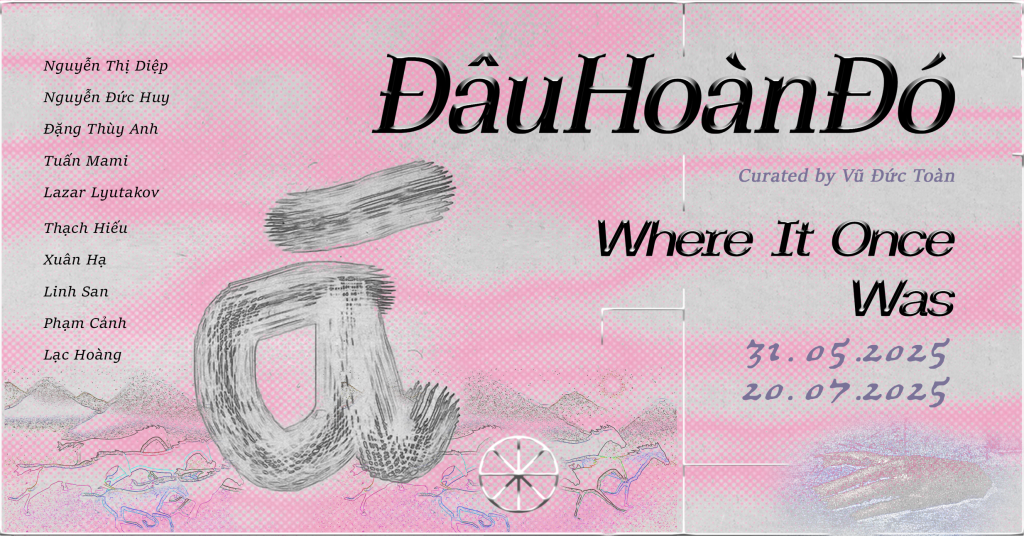
#Time: 31.05 – 20.07.2025
#Location: Á Space, Ngõ 59 Ngô Gia Tự, Long Biên, Hà Nội
#Participating artists: Đặng Thùy Anh, Phạm Cảnh, Nguyễn Thị Diệp, Xuân Hạ, Thạch Hiếu, Lạc Hoàng, Nguyễn Đức Huy, Lazar Lyutakov, Linh San, Tuấn Mami
#Curator: Vũ Đức Toàn
We extend our heartfelt thanks to all the participating artists, whose trust and companionship have supported Á Space throughout the making of this exhibition.
We are also grateful for the support of Nguyễn Long Biên, Nguyễn Hữu Hải Duy, Nguyễn Đức Phương, Thạch Hiếu, Lê Xuân Tiến, Thư An and Nguyễn Huy An.
Graphic design: Đặng Thuỳ Anh
#Program
Where It Once Was is a site-specific exhibition that unfolds not only in conceptual terms, but also in its physical setting. Will we see beloved artworks by dear artists return to their exact spots, repeating their former positions? It is entirely possible.
This exhibition brings together artists who have previously exhibited at Á and reunites the works that once illuminated its space.
Near the entrance, slightly above eye level, hangs a small, delicate painting by Nguyễn Thị Diệp, with another of her works positioned beside it. Eight Horses Chasing the Winds by Nguyễn Đức Huy gallops across the wall on a screen. On the floor, a square wooden panel, darkened with age and cracked with time, holds the sounds of Đặng Thùy Anh. Further along, two green-toned paintings by Nguyễn Đức Huy depict mountains and grasslands in oil paint. Scattered throughout the room are enigmatic objects. A familiar green scale by Thạch Hiếu, now rendered strangely unfamiliar. Small glass blocks tucked into discreet corners, glowing just as Xuân Hạ intended. Also in this room is a glass work which, without the hands and mind of Lazar Lyutakov, would remain mere household objects. A long tale from the 57th Venice Biennale—where IKEA had no chance to intervene. In the inner room, a bold, flowing, milky-white video projection endlessly streams across a wall—again, a work by Nguyễn Thị Diệp. Fragmented white ceramic pieces by Linh San embody a particular philosophy of pottery. Nearby, another work of hers is placed near the foot of a spiral staircase. Another shade of white once occupied this space—milk powder. Just before the exit, a large photograph of a topless woman with flowing hair captures Đặng Thùy Anh mid-action. Opening this door leads directly from Á’s premises into Bác Thà’s home. On the second floor of Bác Thà’s house is a special room belonging to his youngest son, Nguyễn Anh Tuấn. This room is very special – in one’s breath, nothing stands still. Further upstairs, the rooftop garden—host to many gatherings—will now feature a visual feast by video artist Lạc Hoàng. Returning to the ground floor, stepping outside, one encounters Mr. Quang, Mrs. Thà’s other son, who runs a printing business. His large-format printer churns out oversized banners with the acrid scent of ink. A continuous stream of cloud imagery, part of Phạm Cảnh’s photographic work, emerges from the printer—an endless expanse of humble, everyday material.
The moment the idea of the exhibition flashed in my mind was also when I thought of Cường, an architect and translator, a friend of ours. Once he led me to a very beautiful sentence by Trần Nhân Tông:
“Nhất hồi niêm xuất nhất hồi tân.”
(Each time something is brought forth, it is entirely new.)
At the time, I didn’t fully understand it, though I could feel its weight. I asked Cường if it roughly meant that each time something is brought up again, it becomes new in some way. Cường said that was essentially correct and explained further to help me see more deeply the relationship between repetition and change, and movement. Each time something is brought up again, even if it looks the same, the “self” in each instance is no longer exactly the same. The surrounding world has also changed—it cannot be exactly as it was. So each repetition becomes, in truth, a singular and new moment.
That’s why, in our letter to the artists we cherish, there was this passage: “We hope that we will share beautiful moments in an exhibition on a May day there—so we might glance back at the past and see that it (the work) is still there, yet not quite the same anymore. It is breathing for today, just as the artists are—so long as we are still breathing, we are still making and thinking about art, whether persistently or only from time to time.”
Vũ Đức Toàn (translated by Châu Hoàng)